
Techniques
How we print
How 3D printing works, which printers we use, what the settings do and how the price is made.
01 · TECHNIQUEWhat is FDM printing?
Most of what you order on the site is printed with FDM, short for fused deposition modelling. It is the most common kind of 3D printing and the best fit for strong parts you actually use.
It works a bit like a very precise hot glue gun. A thin thread of plastic, called filament, comes off a spool and is pushed into a hot nozzle, where it melts. The printer moves the nozzle and lays the melted plastic down in thin lines, one layer at a time. Each layer is a fraction of a millimetre thick and melts onto the one below, so a part a few centimetres tall is built from hundreds of layers.
A hotend, cut in half. Cold, solid filament goes in at the top, melts in the heater block and leaves the nozzle as a thin line that builds your part layer by layer. Hover a part to see what it does.
Walls on the outside, infill on the inside
A printed part is rarely solid plastic. The printer first draws a few solid outlines, the walls, and closes the top and bottom with solid layers. Inside, it prints a light pattern called infill. That keeps the part strong where it matters while saving plastic, weight and print time. It is also why the walls and infill you pick change the price.
Good to know
- Layer lines show. Every FDM print has fine lines along its sides. Thinner layers make them smaller, and matte and darker colours hide them best.
- Strongest along the layers. A part is stronger along its layers than across them, a bit like the grain in wood. That is why we decide how every part lies on the print plate: flat side down, with the layers where they make it strongest.
- Overhangs need support. Plastic can't be printed in mid-air. Where a part hangs out at more than about 45 degrees, the printer builds a thin support underneath, which we remove by hand. The surface can be a little rougher there.
- Made for real use. The plastics we print are the same kinds used in everyday products, so parts can be screwed down, clipped on, dropped and used outdoors.
02 · PRINTERSWhy we print on Bambu Lab
We print every FDM part on Bambu Lab printers because they give the same clean result print after print. That is what lets us show a fair price in seconds and ship your part in as little as 24 hours.
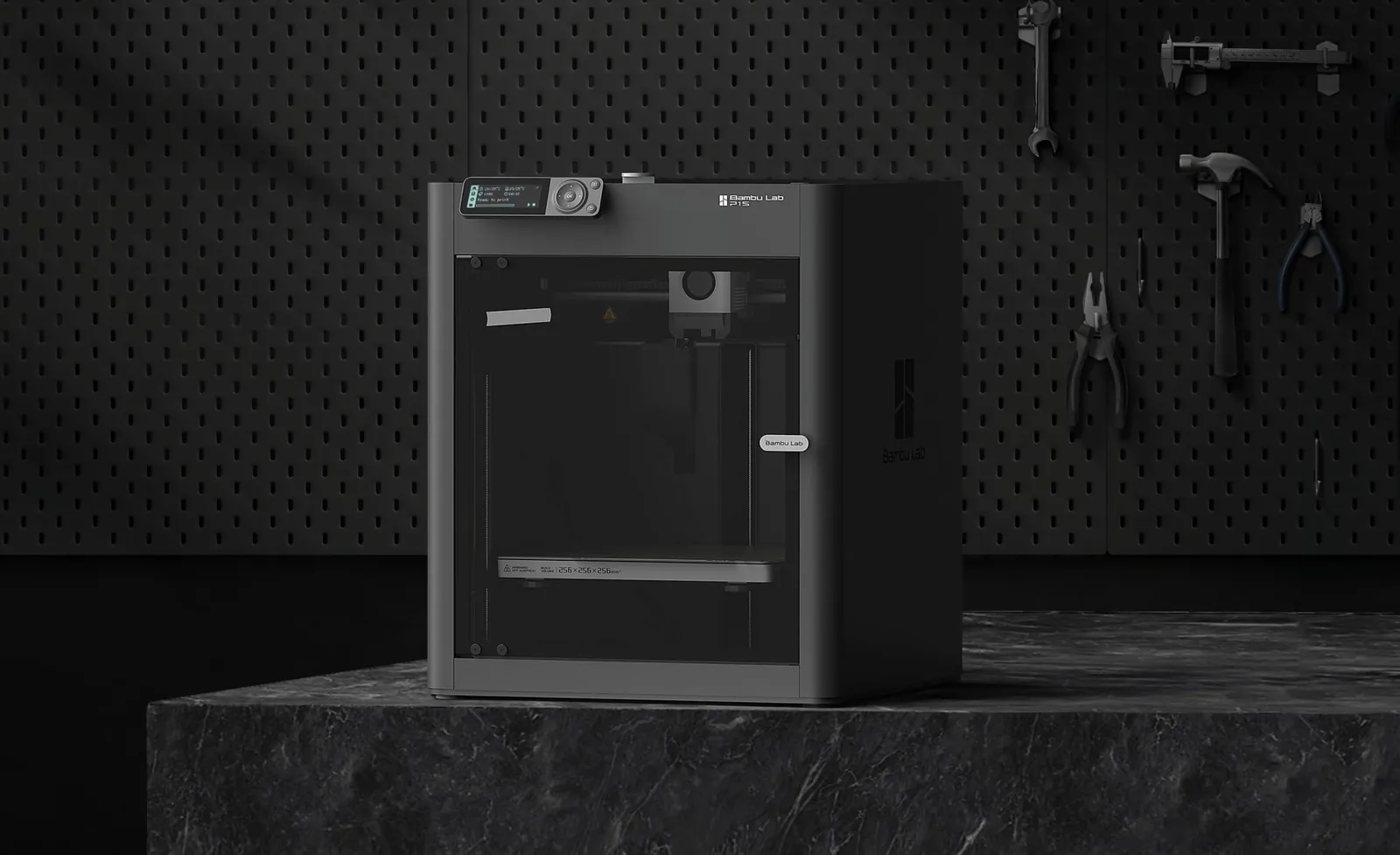
Before a print starts, the printer checks and levels the print plate on its own. The first layer, which decides whether a print turns out well, comes out right every time.
They measure their own vibrations and cancel them out, so they can print fast and still keep sharp corners and clean surfaces.
Because every print comes out the same, we could tune our price calculator against real slices of real parts in Bambu Studio, the software that runs the printers. The price you see is close to what your part really takes to print.
Most measurements come out within ±0.1 mm of your file. Holes usually come out 0.1–0.2 mm smaller, because each printed line bulges slightly into the hole, so draw holes for screws and shafts 0.2 mm bigger.
Resin: Anycubic Photon P1
For parts that need finer details than FDM can give, we also print in grey resin on an Anycubic Photon P1, with layers down to 20 µm. You upload the file on the resin page and see the price there.
Read more about resin printing
03 · SETTINGSLayer heights, walls and infill
Every part starts on our recommended settings, so you never have to touch them. If you want to fine-tune, this is what they do.
Layer height
Parts are printed in thin layers. Fine (0.12 mm) gives the smoothest sides and finest detail but takes longest. Standard (0.20 mm) suits most parts. Rough (0.28 mm) is fastest and cheapest, with visible layer lines. Pick Fine for small, detailed parts and curved surfaces you look at up close, and Rough for big, simple parts where price matters more than looks.
Strength
How solid we print the part. Standard suits almost everything. Strong uses more walls and fuller insides for parts that hold weight, get screwed down or take knocks.
- LightFor looks and light use · 2 walls, 10 % infill
- StandardEveryday use. Our default · 2 walls, 20 % infill
- StrongCarries weight or takes knocks · 4 walls, 30 % infill
Walls
The solid outer shell, counted in lines (each about 0.4 mm). Walls give most of the strength. 2 is standard; 3–4 for screw holes, clips and parts under load.
Infill
How full the inside is. 20 % is standard. More infill makes a part heavier and harder to crush, but walls matter more for strength.
Infill pattern
The shape of the structure inside the part. It changes strength, print time and price a little. Grid suits most parts; Gyroid is the strongest all-round.
Orientation
We print every part in its strongest, cleanest orientation. Need a specific one? Email us with your order number and tell us how.
Scale
Make the whole part bigger or smaller, from 5 % to 500 %. 100 % is the size in your file. Size and price update as you go.
04 · PRICEHow the price is made
What you pay for
Three things: a small fixed amount for preparing and finishing each part, the plastic it uses and the time it spends on the printer. PETG and TPU cost more than PLA, because the plastic is dearer and prints slower. On the custom parts page, How we got this price shows the whole sum.
Handling
39 kr once per order, for checking your files, setting up the prints and packing. It is not per part: order three different parts and you still pay it once.
Quantity
Order more and each part costs less: −5 % from 2 parts, −10 % from 5, −20 % from 10 and −25 % at 25. Small parts get the full discount because many fit on one print plate; big parts get a little less. Handling is paid once per order.
- 2 parts−5 % per part
- 5 parts−10 % per part
- 10 parts−20 % per part
- 25 parts−25 % per part
Shipping
We weigh your parts and screws and pick the smallest package they fit in. Over 4.5 kg? Email us and we'll arrange the shipping. Express moves your order to the front of the queue.
- Letterup to 50 g · 25 kr
- Smallup to 250 g · 49 kr
- Mediumup to 500 g · 69 kr
- Largeup to 1 kg · 89 kr
- Extra largeup to 3 kg · 149 kr
- Heavyup to 5 kg · 199 kr
- Express+149 kr, packed and sent first
A set or something special?
Several different parts, a whole set or something out of the ordinary: email us and we send a quote within the day.
Picking a material? See our three materials and how to choose.
Getting a file ready? Read How to get a good print on our blog.